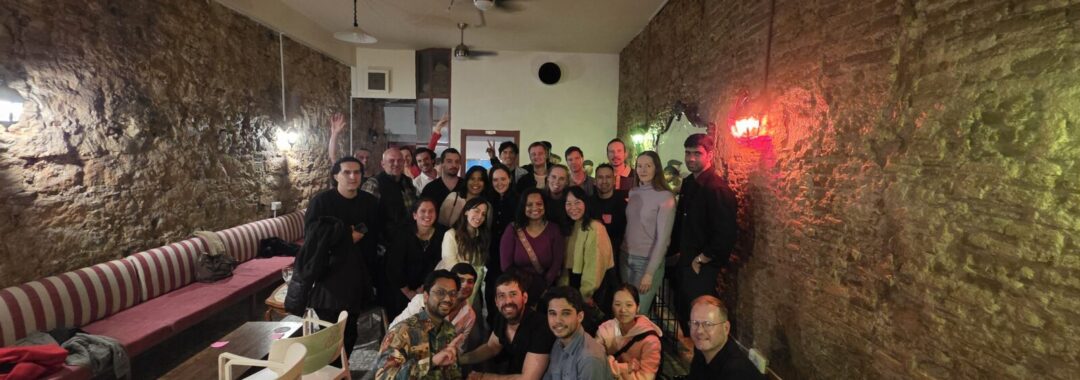
International Saturday meetup in Barcelona at Charcha restaurant with expats and locals meeting new people

Saturday Meetups at Charcha: A New Weekly Tradition in Barcelona

Every Saturday we host our international meetups at Charcha, located at Carrer de Avinyó 24 in the heart of Barcelona, starting at 19:30.

Last Saturday was incredible — we had a wicked time with a large international group of expats, travelers, and locals. People from many different countries came together to socialize, share experiences, and enjoy a great evening in a relaxed atmosphere.

From 19:30 until around 2 AM we enjoy great conversations, drinks, and the chance to meet new people. There is also the possibility of karaoke, so if anyone feels like singing, the night can become even more fun and memorable.

If you want to stay updated and see who’s coming to the next meetup, join our Saturday WhatsApp group here:

👉 Join the Saturday Meetup WhatsApp Group

See you next Saturday!

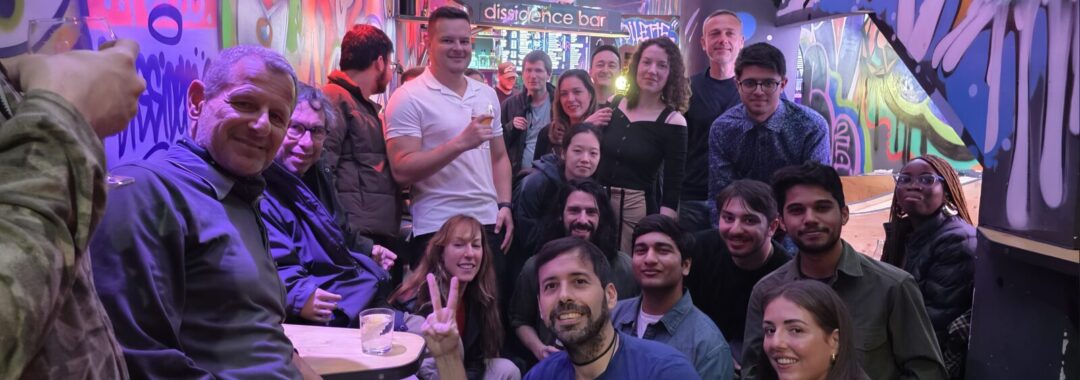
International expats meetup at Dissidence Bar Barcelona Friday night New in Barcelona community

New Friday Meetup Spot in Barcelona: Dissidence Bar

Last Friday we had our first Friday meetup at Dissidence Bar in Barcelona and it turned out to be a fantastic night. Around 30 people from different countries joined the event…

Our First Meetup at Dissidence Bar

Last Friday we had our first Friday meetup at Dissidence Bar in Barcelona and it turned out to be a fantastic night. Around 30 people from different countries joined the event, creating a very international and friendly atmosphere. Some people were new to the city while others had been living in Barcelona for a while, but everyone was excited to meet new people.

Throughout the evening, people shared stories about their experiences in Barcelona, talked about travel, work, and life in different countries, and of course enjoyed a few drinks together. The colorful graffiti-style interior of Dissidence Bar gave the place a really unique vibe and made it a perfect spot for our meetup.

A Very International Group

One of the best things about our meetups is the diversity of the people who join. On this night we had participants from many different countries, including Europe, Asia, and the Americas. It was great to see new friendships forming and people exchanging recommendations about places to visit in Barcelona.

Many attendees mentioned how nice it was to find an international community where they could easily meet new friends in the city.

Our New Friday Meetup Location

From now on, all our Friday meetups will take place at Dissidence Bar.

🕗 Every Friday starting at 8:00 PM
🍻 The bar stays open until around 2:00 AM

People usually arrive between 8:00 PM and 10:00 PM, but you can join at any time during the evening.

Join the Friday WhatsApp Group

If you want to know who is coming to the meetup or stay updated about the next events, you can join our WhatsApp group:

👉 Join the Friday Meetup WhatsApp Group

If you are new in Barcelona and looking to meet people from different countries, our weekly Friday meetup is a great way to connect with the international community. Expats, travelers, and locals join every week to socialize, have drinks, and make new friends in Barcelona.

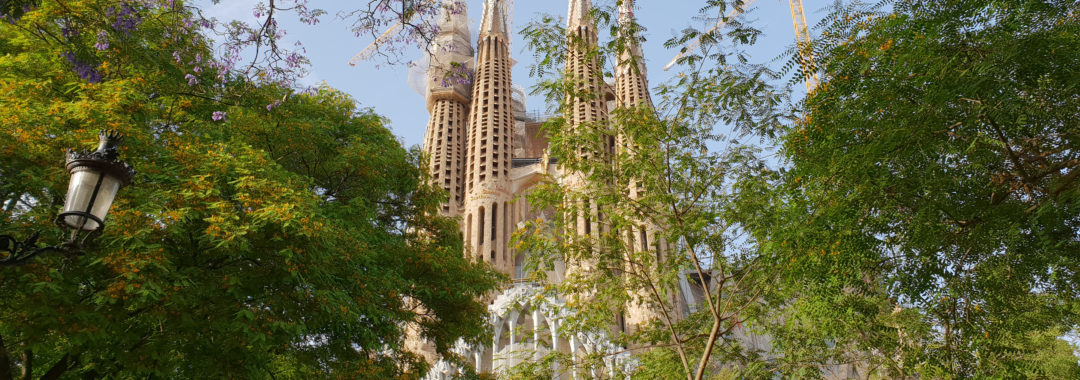
The Basilica of the Sagrada Familia

The Basilica of the Sagrada Familia

 A huge source of revenue for Barcelona tourism: The Sagrada Familia, this awe-inspiring cathedral draws in around 2.8 million visitors every year. In fact, this is the most visited monument in all of Spain.


If you have only one opportunity to go sightseeing in Barcelona, make sure it’s this. Read on to find how to maximize your Sagrada Família trip.


Construction

Designed by Barcelona’s famed architect Antoni Gaudí, the full name of this monument is the Temple Expiatori de la Sagrada Familia (in English, that’s the Expiatory Temple of the Holy Family). It was Gaudí’s overpowering obsession, his pièce de résistance.


A conservative society commissioned Gaudí to construct a temple as atonement for the sins of modernity, which the architect took to heart as his sacred mission in life. Work began on the temple in 1882 (yes, you read that right) and to this day, it hasn’t finished. There are hopes that it will be completed in 2026, though this may be a rather optimistic estimate.


When funds began to dry up, Gaudí donated much of his own money to the completion of the church. However, in 1926, the much-loved artist was hit by one of the Barcelona tramvías. Since he was an artist so dedicated to his work and not one for garishness in his own person, people thought the individual who had been hit was a homeless man. He was treated as such, provided with poor medical facilities, until it was discovered that he was actually the great Gaudí. Nevertheless, he refused transfer to a better facility, and eventually he succumbed to his injuries and died, leaving the Sagrada Familia unfinished.


Design

The temple is 95m long and 60m wide, with a seating capacity of 13,000 people. A central tower stretches 170m high above the transept (which represents Christ), and another 17 towers ascend 100m or more. Twelve of these towers represent Christ’s apostles, and the remaining five represent the Virgin Mary and the four evangelists.


Gaudí designed the basilica true to his fashion, featuring no straight lines in the architecture (he had an idiosyncratic dislike for straight lines, because of their non-existence in nature). The towers thus have outlines that swell a little, apparently inspired by the silhouette of Montserrat just outside Barcelona, and sculptures sitting atop their tips.


When Gaudí died, only the crypt, the apse walls, one portal and one tower had been completed, leaving the rest to a team of architects that took over his mission. By 1930, the northeast façade was 

completed. But then, in 1936, anarchists destroyed the interior, leaving a gap in construction until 1952.


There is much controversy surrounding the construction of the building. Some people lament that much of Gaudí’s original plans were destroyed in 1936 due to a fire that the anarchists caused, and thus the computer reconstructions of these blueprints are not wholly accurate and perhaps not true to Gaudí’s plans and style. Nevertheless, the Sagrada Familia is still a stunning structure that overwhelms the senses when you gaze upon its facades.


Things to see at the monument

The main draw of the building is probably the Nativity Façade, constructed under Gaudi’s meticulous supervision. Three sections of this represent Hope, Charity and Faith. On the Charity portal, you will see the manger surrounded by animals and people, as well as angel musicians. The faces here were taken from plaster casts done of local people, with the odd few made from corpses in the local morgue. Furthermore, many local florae are reproduced in the stone. Above the stained-glass window, Archangel Gabriel’s Annunciation to Mary is depicted, with the mosaic work at the top of the towers made from Murano glass imported from Venice.


To the right is the Claustre del Roser, a cloister attached to the outside of the church. Once inside, make sure you look back at the entrance – there is an ophidian representation of the devil handing a terrorist a bomb, inspired by political violence during the civil war.


You can climb some of the towers featured by the Nativity Façade by a combination of lifts and staircases. Be warned, however, that these staircases are very tight and hard work. The upper parts of the towers are decorated with mosaics, which Gaudí said that the angels would see.


The southwest façade, known as the Passion Façade, is based on the theme of Christ’s death. This was constructed based on drawings left behind by Gaudí; the sculptor who worked on the portal was Josep Subirachs, who produced angular images so as not to imitate Gaudí – a controversial move. The main series of sculptures is an S-shaped sequence that starts with the Last Supper and ends with Christ’s burial.


In front of this is the Escoles de Gaudí, sculpted as a children’s school with an undulating brick roof. Inside, there is a recreation of Gaudí’s office as it was when he died.


The Glory Façade will also be surrounded by four towers when it is eventually completed. Gaudí wanted this to be the most spectacular Façade of the whole structure. Inside will be the foyer consisting of 16 ‘lanterns,’ which Christ represented by the central tower above the transept.


Below the church, the Museu Gaudí depicts the artist’s life and works as well as models and photos of the basilica. A side hall at the 

eastern end leads to a viewing point above the crypt in which he is buried.


The inside of the basilica is just as stunning, with light streaming through stained-glass windows to create a kaleidoscope effect throughout the interior. Make sure you don’t miss the intricacy of the pillars supporting the structure.


Visiting the Basilica

You can catch the metro to the Sagrada Familia on the Blue Line, L5 and the Purple Line, L2, or catch one of a number of bus lines that run to the site. It is fairly central in Barcelona and therefore easy to access.


It costs €15 to enter the Sagrada Familia, but guided tours are offered for €24. Alternatively, you can grab an audio guide for €7 – either way, it is extremely rewarding to pay extra for information on the church and how it was build. Be aware that, since it is so popular, queues for the visit can be extensive, commonly exceeding 2 hours.


For an extra €14, you can get into the lifts that rise up the towers in the Nativity and Passion facades, but this must be pre-booked online.

Book your visit with this link

Are you looking for anything else? go to this link

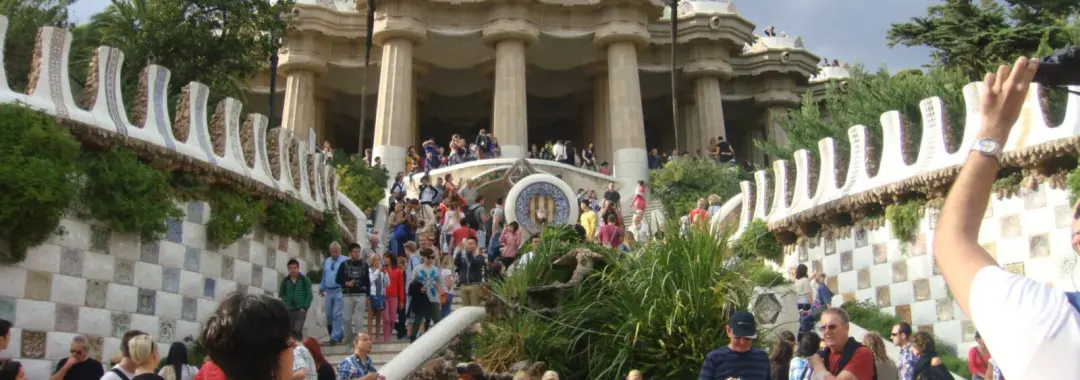
Parc Guell

Park Guell

Visiting Park Güell

Tourists flock to this living, breathing city-monument to see structures designed by the architect Antoni Gaudí. Architecture built by this man has a very distinct look – and feel – to it, one that captures the eyes and hearts of visitors when they gaze upon the late artist’s work.

One of these such works is Park Güell, one of the more popular of the Gaudí attractions sprinkled throughout Barcelona. This article is a handy guide to visiting the park, including all you need to know to sound intelligent when you act as tour-guide for your friends and family.


About the artist

Antoni Gaudí was born and raised in Catalonia. He was actually born in the city of Reus in 1852, suffering from Rheumatism as a child. Young Gaudí spent a lot of time interacting with animals and nature, which certainly inspired his later art (Casa Batlló, for instance, seems to resemble a shimmering fish). His admiration for nature shone through for the duration of his life, demonstrated in his vegetarian lifestyle as much as his art.


He first arrived in Barcelona in the year 1868, becoming an architecture student. His professors, as is often the case with prodigies, either thought his work was downright awful or placed him on a pedestal as a genius. After his graduation, the city of Barcelona seemingly took a gamble when they commissioned Gaudí to design the lampposts in the Plaça Reial. If you visit the plaza, remember to look up and take in the very Gaudí-style heads on the lampposts, adorned with swirls and spikes and subtle hints at the natural world.


Gaudí went on to become a very famed artist in Barcelona, and is even considered the father of the Modernism art movement.


The history of Park Güell

Gaudí’s passion for nature rears its head most obviously in Park Güell, where architecture and the man-made blends almost imperceptibly with the natural world around it.


In 1900, Count Eusebi Güell purchased the expanse of land on a hillside decorated with trees and hired the then-popular artist to design a miniature city of houses specifically for the wealthy. Somewhat fortunately, the project was not a success story, and in 1914, the idea was abandoned. However, this was not before Gaudí had already begun his landscaping project, creating 3km of roads and walks, steps, a plaza and two gatehouses. The city bought the estate in 1922, and thus it became a public park.


Things to see

Just inside the entrance are the two gatehouses, displaying the typical Gaudí style of wavy terraces and subtle accents. The Centre d’Interpretac used to be a porter’s home, but now it holds a display on Gaudí’s building methods and the history of Park Güell. Make sure to check out the top floor for a stunning look-out point.


The steps stretching up from the entrance are guarded by a mosaic reptile, boasting vibrant hues of blue, green, orange and yellow. This is quite a symbol of the park and even the city, and a great photo op for tourists.


Above this is the Sala Hipóstila, a forest of 86 columns made of stone. Although man-made, the columns really appear like trees, bending and leaning and carved ornately like bark. Gaudí certainly paid attention to detail.


Atop this is the Banc de Trencadís, a tiles bench which winds around a terrace overlooking the park below. This was actually designed by Josep Maria Jujol, a close friend of Gaudí, but in very typical style, it is never as simple as it seems. The ‘bench’ acts as a catchment for rainwater that runs down the hillside; the water filters through stone and sane and drains through the tree-like columns to an underground cistern.


The Park is also home to the Casa-Museu Gaudí, where the architect lived out his last 20 years. The structure still contains furniture of his own design, including items brought in from other locations. It was built as a prototype for the other houses that were originally intended to be built in the park.


Now, the Park is a UNESCO-listed property, making it a very rewarding visit for tourists who come to Barcelona.


Visiting the park

Park Güell is located just to the north of Gràcia, which actually used to be a city separate from Barcelona until the 1890s. You can take the Metro to Lesseps and then walk to the park, but this requires a lot of uphill walking (followed by a long walk around the expanse that is Park Güell) and is not necessarily the fastest route. Alternatively, take Bus 24 or 32, which drops off visitors right by the gates.


It is estimated that around four million people visit the Park per year. Authorities limit access to a certain number of people per half-hour, meaning that sometimes, it can be difficult to get in. If you are planning your Barcelona trip during peak tourist season (i.e. summer), it can be advised to book ahead and perhaps visit the Park early in the morning. Booking ahead also saves you a euro on the admission fee.

The park is open from 8am-9:30pm from May-August but closes earlier at other times (closing at 8:30pm in April, September and October, and at 6:30pm from November through to March). The admission fee is €8, or €5.60 for children, but admission into the Casa-Museu Gaudí will put you out another €5.50 (definitely worth it if you’re interested in all things Gaudí!).


Final tips

It can get hot when walking around the Park, so make sure you bring sunscreen and a hat, or perhaps even sunglasses. Considering the fact that the Park is on a hill, make sure you wear appropriate footwear to navigate the terrain, and prepare to do some walking.


There are some restaurants or cafes in the Park, but these can be expensive. Perhaps take along a packed lunch and a bottle of water and indulge in a lovely picnic on the curvaceous bench on the terrace.


Finally, there are plenty of wonderful sights to see in Park Güell, so don’t forget your camera!

Montjuic

Montjuic

Visit Montjuïc


Situated not too far from Barcelona city center is Montjuïc, a hill standing at 173m above sea level. The towering landscape lies right beside the sea, offering brilliant views of the coast as well as providing a great day out for visitors and locals alike.


A key site for Barcelona tourism, there is much speculation about the origin of the hill’s name, but many theorise that it comes from “Mountain of the Jews,” referring to the medieval Jewish cemetery that was found on the hillside. Others think it derives from “Monte Jovis” due to the possible existence of a Roman temple at this site that was dedicated to the God Jupiter.


Whatever your beliefs about the name, Montjuïc has a lot to offer for tourists. It is often known as Parc de Montjuïc (Montjuïc Park) thanks to its leafy trees and fresh, alpine air. But, aside from the beauty of the place, there are lots of things to do. Check out the best tourist spots below to make the most out of your visit.


CaixaForum

Contemporary art lovers will thoroughly enjoy the CaixaForum and its marvellous collection. Even the architecture of the building is stunning, with the artworks housed in a renovated factory that even served as the HQ for the First Squadron of the police cavalry unit for much of the 20th Century.


Entry to the museum is €4 (free for children) but be aware that the 1st Sunday of each month is free! And, during the warmer months, the CaixaForum sometimes hosts musical events, so be sure to check out their webpage for more information.


MNAC

Museu Nacional d’Art de Catalunya (or MNAC), is another one for the connoisseurs of art. At the more expensive price of €12, MNAC was constructed for the World Exhibition in 1929, and houses a timeline of Catalan art spanning from the Middle Ages to the early 20th Century.


The Romanesque Frescoes draw the most attention, including Christ in Majesty (dated around 1123) and Virgin Mary and Christ Child. Amongst the medieval works are items of Modernista furniture and decorations, including a mural by Roman Casas that once decorated the bar and restaurant Els Quatre Gats (Picasso’s favorite hangout).


If you’re here for Barcelona sightseeing, then why not see it all from the top? Skip the art and go straight to the rooftop viewpoint; the admission price is €2 for a stunning photo op.


Museu Etnològic

If you are interested in Catalonian history, this museum is for you. The ethnology museum has a permanent collection displaying exhibits on myths, religious festivals, folklore, and other treasures from Barcelona’s past.


Don’t miss the massive gegants (figures made of papier-mâché) of King Jaume I and Queen Violant. There is also a dragon and devil costumes that are used in the correfocs (fire runs), which you can see in Catalonian festivals.


As with the two museums above, the first Sunday of the month is free for visitors (in this case only between 4-8pm), but the usual price is €5.


Jardí Botànic

Montjuïc has its fair share of parks and green spaces to lounge and get some breathing room away from Barcelona’s architecture, and one of the most

beautiful places to do this is the Jardí Botànic. The garden is dedicated to Mediterranean flora and contains some 1500 species. It costs €3.50 to enter the gardens, but is free after 3pm on the first Sunday of the month.


Plaça d’Espanya

This roundabout is one of Barcelona’s most important squares. It was built for the International Exhibition. It can be distinguished by the Venetian Towers, named for their resemblance to the belltower in Venice’s St Mark’s Square. Another key feature of the square is the Arenas de Barcelona, which was formerly a bullring. It was constructed in Moorish style, but has since been converted into a shopping center.


The Arenas has a viewpoint that is great for looking out over Barcelona. The escalators inside the mall are free to use, but the outside lift has a price of €1.


Montjuïc Castle

Sitting at the highest point of the mountain lies Montjuïc Castle, offering breathtaking views of both the coastline and the city. The castle is steeped in history, such as its role in the Spanish Civil War and its period as a prison. Now, the castle has some temporary exhibitions and hosts a few cultural events. Most visitors, however, visit the castle for its view.


You will need to pay to enter the castle, which will set you back €5. Try visiting the viewpoint just before sunset to watch the sun go down over the city.


Estadio Olímpic Lluís Companys

When Barcelona has hosted Olympic games in the past, this stadium is the main location for the sporting events. It sits right at the heart of Montjuïc and was opened in 1929 but has been restored a few times since. It is now a 54,000-capacity stadium, used for sporadic events including sporting and musical.


Visitors can see a small portion of the stadium free of charge by entering under the Olympic Torch.


El Poble Espanyol

The ‘Spanish Village’ is a wonderful attraction that many visitors love to see. It incorporates architecture and design from all the regions of Spain, giving an intriguing insight into the cultural differences across the country. It takes a few hours to wander around the 117 buildings, which includes 17 restaurants, cafes and bars, and 20 craft shops as well as places to buy souvenirs.


It costs €14 to enter, or €7 for children, but splashing out €3.50 extra on a multimedia guide is well worth the price (you will need to leave a €20 deposit to ensure you return it).


Getting to Montjuïc

Now that you’re probably sold on the trip to Montjuïc thanks to all the Barcelona tourist attractions to tick off your list, how do you get there? There are a number of ways to get up the hill, including by foot if you are situated nearby. Metro Stops nearby include Espanya, Parallel and Poble Sec, which are serviced by Lines 1, 2 and 3. Many of the bus lines also run to Montjuïc. For a more fun experience, you can catch the Funicular at Parallel Metro Station and use the same metro ticket to get up the mountain. Alternatively, you can take the Aeri del Port Cable Car, running from the Sant Sebastià tower in La Barceloneta (a return ticket is €16.50).


Montjuïc is definitely one of the best things to do in Barcelona, with plenty of places to visit and things to see.