Feel the Burn and Have Fun with Barrefit!

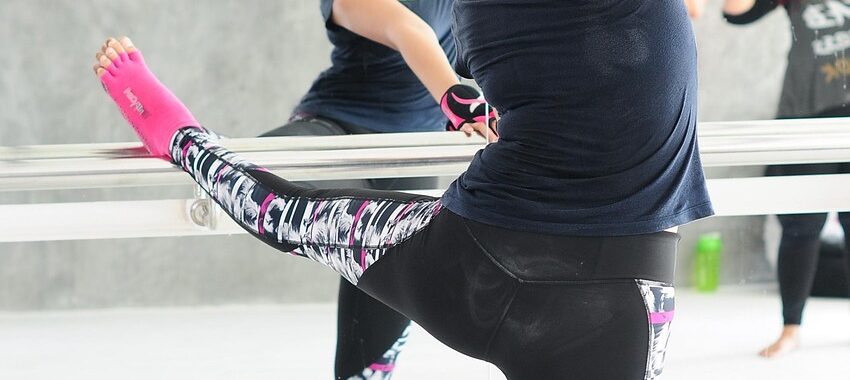
Barrefit is a fun, energetic workout that combines ballet-inspired moves, pilates, and strength training. This high-intensity, low-impact workout targets major muscle groups like the arms, legs, glutes, and core. Using precise movements and high-repetition micro-movements, Barrefit is designed to work even the tiniest muscles. You’ll definitely feel the burn—and maybe even your leg will shake XD—but over time, you’ll improve your posture, alignment, and muscular endurance.

Most exercises are done at a ballet barre, which helps with balance and keeps your core engaged throughout. Lower body moves like plie squats, arabesque pulses, and calf raises are paired with controlled leg lifts to tone and strengthen. For the upper body, arm circles with hand weights target shoulders and arms, while glute-focused movements add that extra burn.

Classes also incorporate tools like resistance bands, sliders, pilates balls, and yoga blocks to enhance your workout. These props help you maintain proper alignment, ensuring you activate the right muscles instead of relying on larger ones to compensate.

Barrefit offers a full body toning experience, working every muscle group for a lean, toned physique. It also improves flexibility, especially in the hips, hamstrings, and spine, making daily movements feel easier. The controlled movements also help improve balance and coordination, giving you a strong foundation for other types of exercise.

The classes are fun and dynamic and the music matches the pace of the exercises, so you feel like you are flowing with the beat.  The higher intensity barre classes combine traditional barre with cardio and an energetic playlist. Whilst the slower flows focus on toning muscles and more relaxed music. Whatever type of barre you are in the mood for, be assured that the classes fly by. You don’t have to be a dancer to try barre, however those with a dance background will surely be drawn to it.

One of the greatest benefits that Barrefit encourages, is the is the mind body connection. While you are focusing on the tiny muscle movements and maintaining the correct form, your mind is much less likely to wander, thinking about work or what you are guna cook for dinner! You won’t get distracted, when you are following different instructions at the same time, such as holding on to the ballet barre, squatting, tucking and pulsing. Barrefit allows you to be fully present in the moment and in your body, while having the knock on effect of reducing stress, and helping overall mental clarity.

As barrefit is low-impact it also has the benefit of being joint-friendly. It works well in tandem with other high impact exercises that you might do. The quick transitions from one movement to another, will get your heart rate up and increase your stamina.

So why not give it a try? 😊 Class Pass allows you to book a class near you ClassPass | Book Fitness Classes & Salon Appointments


New in barcelona

Welcome to the New in Barcelona community!

Hello, my name is Ricardo de la Torre and I’m the owner of the expat community ‘New in Barcelona’ and controller of the below Facebook communities:

WELCOME to our WhatsApp communities! I will explain to you how the community works…

About the Community

Basically, these groups are meant to help members of the community connect with each other and suggest or join different activities in Barcelona, or support each other on topics like job and apartment searching. Ultimately, we hope you meet friends and feel a sense of community, especially if you’ve just arrived in the city.

I have around 100 WhatsApp groups and 2 Telegram groups, some of which are used for events I regularly organize within the community (weekly meetups, weekend excursions, language exchanges) and others which are open for members to suggest activities and plan activities together (eg. Beach volleyball, running, dancing, festivals). You can find the full list of WhatsApp groups here.

We have regular weekly meetings every Wednesday, Friday, and Saturday at La Terraza de La Marina Bar-Restaurant (Carrer de la Marina 22)

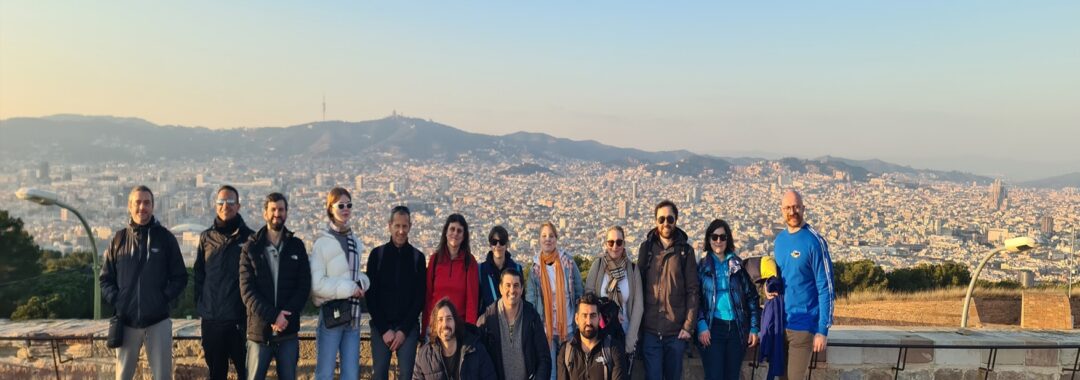
I also regularly organize excursions such as walking tours around Barcelona (7-24km) and day trips to places like Montserrat, Girona, Sitges, and more. In the summer we enjoy organizing community picnics in the park or beach and sometimes we even organize group dinners and karaoke nights. You can check the upcoming calendar here to see what we have planned for the month.

Every 2 months we also organize one big BIMONTHLY MEETUP where we expect between 70 to 130 attendees – Mark your calendar and don’t miss out!

We suggest you to join the WhatsApp sub-groups of your interests to connect with people who have common interests, for example if you want to meet people for board games, bachata dancing, going to the cinema, or playing a particular sport.

In the events that I do, there are many members who join regularly so you can easily form friendships, and also there will always be new people who are joining for the first time.

Suggestions and Rules for the WhatsApp Groups

Firstly, we suggest to put the WhatsApp group messages on silent because we don’t want you to receive too many notifications, especially if someone writes at 5am in the morning! (In the WhatsApp group go to the Settings in the top right corner and choose ‘Mute notifications’)

Secondly, please remember that all New in Barcelona events are free for you to attend* and I do not get paid as the organizer – This is my hobby for after work!  (*At bar meetings it’s expected to buy at least one drink to support the bar, and we do occasionally organize dinners or events where we will always mention the cost beforehand.)

The Rules:

  1. Respect the other people
  2. Do not harass fellow group members or send unsolicited private messages. If they don’t want to talk with you in private, respect it. This is not Tinder. We have a Singles group but it is also not allowed to send private messages there unless someone explicitly gives their consent in the group chat. If someone writes to you in private who you don’t know and don’t want to interact with, please send me a screenshot so that I can send them a warning and repeat the rules.
  3. I have the right to kick anyone out of the group who does not follow the rules
    • Yellow card and warning for first offence
    • Red card and you are expelled for 3 months
    • Forever-ban if you have done something very bad
    • I will announce yellow and red cards publicly in the group chat as well as privately.
  1. Do not advertise events which are similar to New in Barcelona events but by other meetup organizations (Eg. Recurring language exchanges, activities which conflict with New In Barcelona meetups). You can talk in private with the fellow members that are your friends already and attend these activities, but please do not advertise as it might attract less people to our existing meetings.
    • Acceptable: Invitations to a concert, jazz club, theater, cinema, dinner, sport
    • Unacceptable: Invitations to attend a Couchsurfing meetup on the same evening as our Friday meetup
    • Acceptable: Speaking with your NIB friends in private to go to another event
  2. Please avoid talking about controversial topics such as religion and politics – Keep it light-hearted!
  3. No discussions about drugs (Alcohol is okay)
  4. By joining our groups you consent to the following:
    • Occasional private messages from admin to inform you about special events (Eg. Bimonthly meetups)
    • Group photos and videos during the events which we used for marketing

Support the Community:

This community is people-powered and we highly value any support you can offer, especially liking, following, subscribing, and sharing our social media efforts:

Please take 1 minute to subscribe and follow our accounts – it helps us a lot!

THANK YOU and enjoy being part of the New in Barcelona community!

New in barcelona

How to get your FREE Renfe train pass for Barcelona

The Renfe/Rodalies train pass was introduced to encourage travel by train at the end of 2022, and the offer is still going until December 2023. You can find the full info here in Spanish but we will give a summary below.

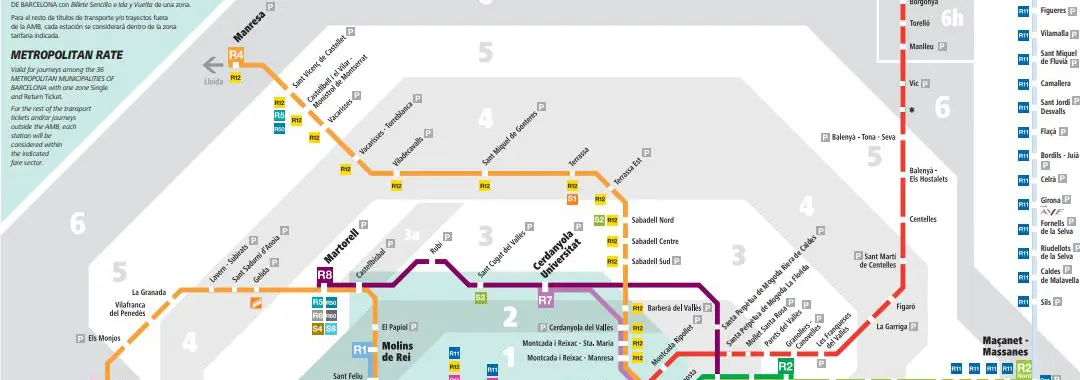
The Rodalies trains are the ones that take you to cities surrounding Barcelona (but not ALL the trains. Keep an eye out for the R trains). Here is a link to the map of the trains and zones. As you can see, there are 6 zones total.

The pass will give you unlimited travel on these trains for the time period when you bought it. Those time periods are as follows:

  • 1 Jan 2023 – 30 Apr 2023
  • 1 May 2023 – 31 Aug 2023
  • 1 Sep 2023 – 31 Dec 2023

Cost: The ticket is “free” however requires a deposit of €10. If you complete 16 or more trips (8 round trips), the deposit will be returned to you. If you don’t do 16 trips, then still €10 is not a bad price to pay for this service (It’s already worth it after 2 trips depending on where you are going).

A few important notes:

  • You must have a DNI/NIE/TIE/Passport number to get the pass, and the ticket is not transferable so you can’t share with anyone
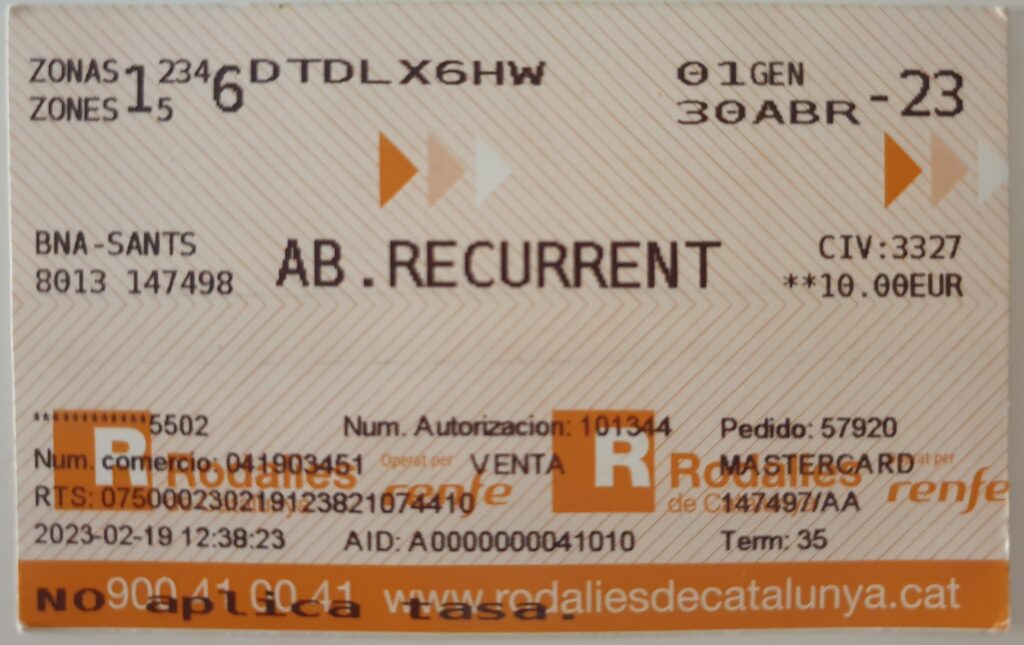
  • You will get a paper ticket which looks similar to a metro ticket. It’s important you do not lose this paper ticket, as you will not be able to get a replacement!
  • It is valid for most but not all of the R-trains. You can take the R1, R2 Nord, R2, R2 Sud, R3 (direction Sant Quirze de Besora), R4, R7 and R8.
  • After you complete a trip and return to Barcelona, for the next 15 minutes you can use the same ticket to transfer via the metro in order to go home.
  • Travel to Montserrat: Note that the ticket is NOT valid for the R5 which takes you directly to Aeri de Montserrat to visit the mountain, however you can take the R4 and change trains in Martorell Central (The price from here is about 6.80 EUR round trip) (The price to go directly on the R5 from Pl. Espana is about 11.50 round trip).

How to get the ticket from the ticket machines

Firstly, note that you should take it from the orange Rodalies ticket machines which are found in the Rodalies stations (Sants, Passeig de Gracia, Pl. Catalunya, Arc de Triomf, Estacio de Franca, El Clot-Arago, La Sagrera being the most central stations but check the map to see if there is one closer to your home)

Just to make things more complicated, Rodalies has 2 types of machines which function a bit differently, so pay attention to which type of machine you find:

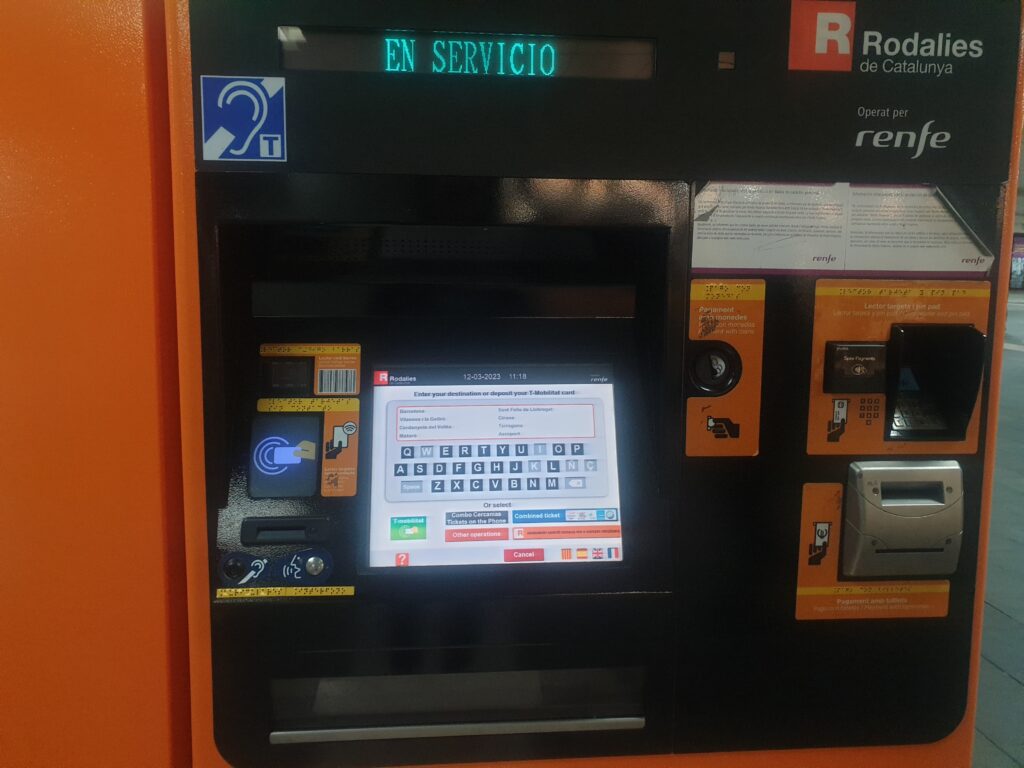
New machine with black interface 
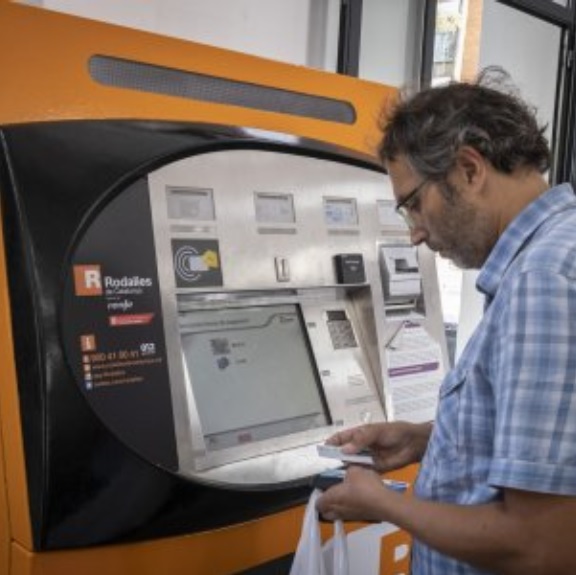
Old machine with silver interface

The next steps are quite simple on both machines. (Scroll down for instructions with the old machine.)

New machines*:
*Easier to use than the old machines, we recommend finding one of these!

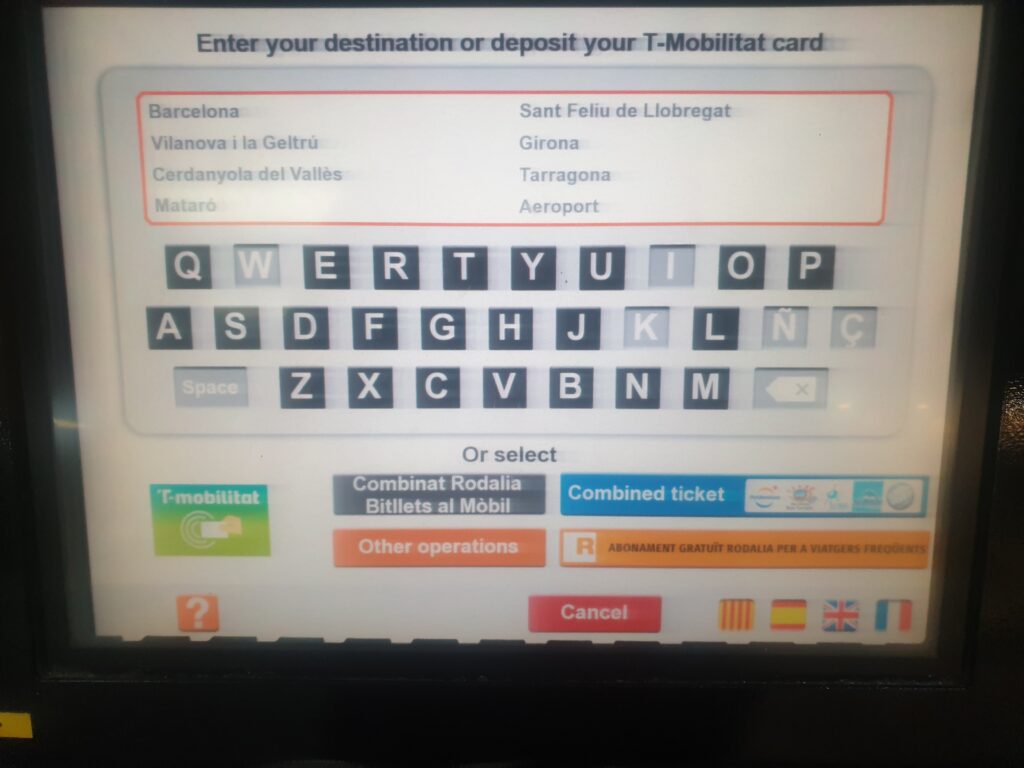
You will see on the main screen a big orange button on the button that mentions the abono gratuito. Click that button.

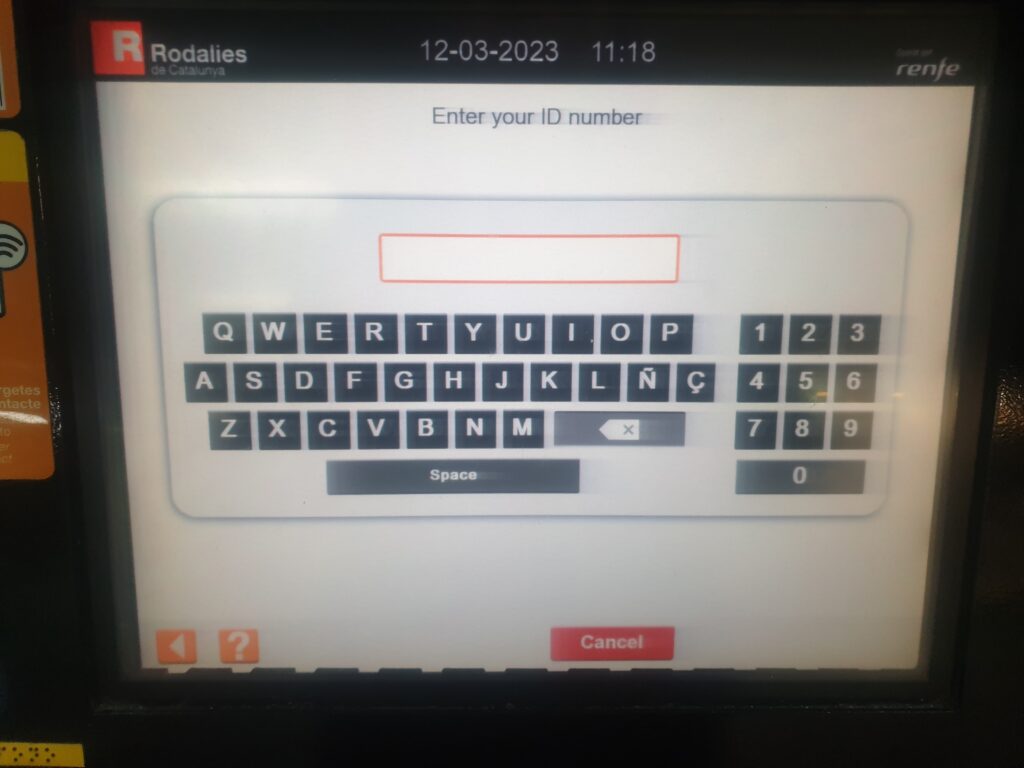
Then, simply enter your DNI/NIE/TIE/Passport #

Make sure on the next page that you select the destination that is in Zone 6. It doesn’t matter the destination, because you can use the ticket on all Rodalies lines. For example, we suggest choosing Manresa.

Then, make the payment of 10 EUR (We recommend using a card so that you can get your money back on that account).

The machine will print you a card. Don’t lose it 🙂

Old machines:

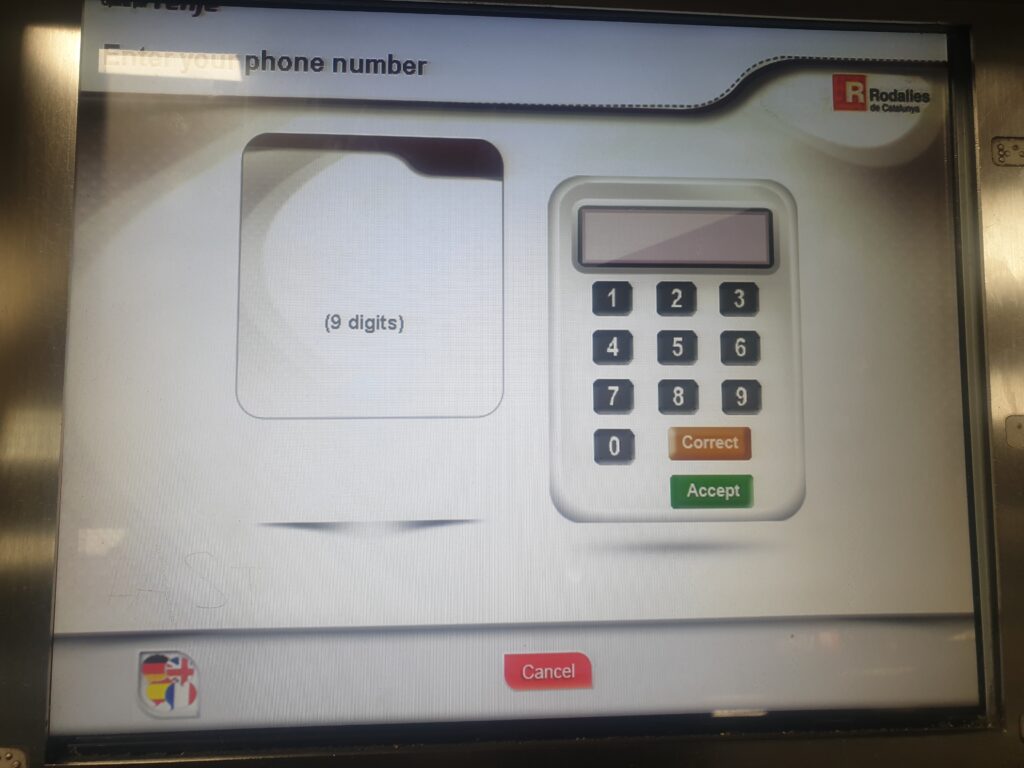
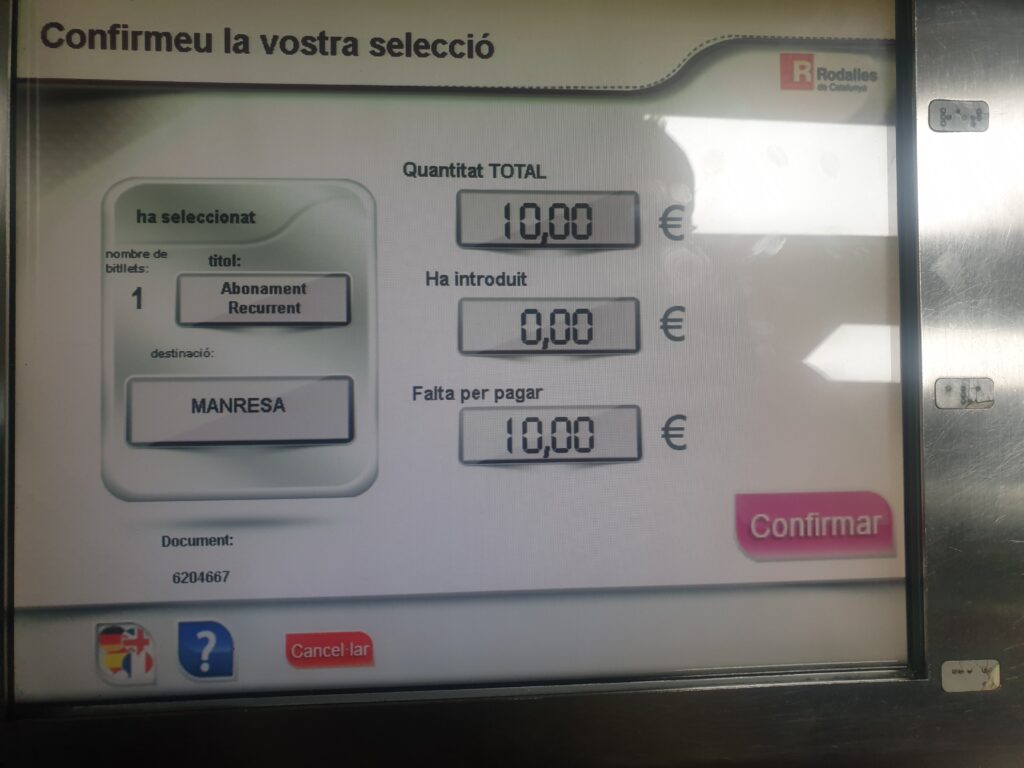
You will see a screen with many options. Choose “Abonament recurrent

Next, it will ask for your phone number AND your ID number (DNI/NIE/TIE/Passport). Enter this information and continue.

Make sure on the next page that you select the destination that is in Zone 6. It doesn’t matter the destination, because you can use the ticket on all Rodalies lines. For example, we suggest choosing Manresa.

Then, you can finalize your payment of the 10 EUR deposit. We recommend using a card so that Renfe can return your money on this account.

The machine will print you a card. Don’t lose it 🙂

Now you can enjoy trips to many cool places surrounding Barcelona, and even join New in Barcelona group day trips to places like Sitges, Manresa, Vic, Castelldefels, Sant Pol de Mar, and more! (See here some pictures of the trips we have taken!)

Have anything to add to this information or find a mistake? Please let us know!

The Basilica of the Sagrada Familia

The Basilica of the Sagrada Familia

 A huge source of revenue for Barcelona tourism: The Sagrada Familia, this awe-inspiring cathedral draws in around 2.8 million visitors every year. In fact, this is the most visited monument in all of Spain.


If you have only one opportunity to go sightseeing in Barcelona, make sure it’s this. Read on to find how to maximize your Sagrada Família trip.


Construction

Designed by Barcelona’s famed architect Antoni Gaudí, the full name of this monument is the Temple Expiatori de la Sagrada Familia (in English, that’s the Expiatory Temple of the Holy Family). It was Gaudí’s overpowering obsession, his pièce de résistance.


A conservative society commissioned Gaudí to construct a temple as atonement for the sins of modernity, which the architect took to heart as his sacred mission in life. Work began on the temple in 1882 (yes, you read that right) and to this day, it hasn’t finished. There are hopes that it will be completed in 2026, though this may be a rather optimistic estimate.


When funds began to dry up, Gaudí donated much of his own money to the completion of the church. However, in 1926, the much-loved artist was hit by one of the Barcelona tramvías. Since he was an artist so dedicated to his work and not one for garishness in his own person, people thought the individual who had been hit was a homeless man. He was treated as such, provided with poor medical facilities, until it was discovered that he was actually the great Gaudí. Nevertheless, he refused transfer to a better facility, and eventually he succumbed to his injuries and died, leaving the Sagrada Familia unfinished.


Design

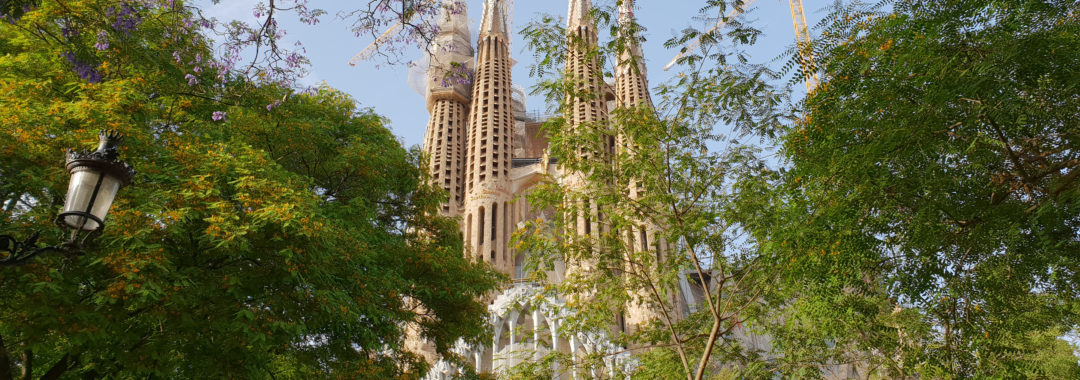
The temple is 95m long and 60m wide, with a seating capacity of 13,000 people. A central tower stretches 170m high above the transept (which represents Christ), and another 17 towers ascend 100m or more. Twelve of these towers represent Christ’s apostles, and the remaining five represent the Virgin Mary and the four evangelists.


Gaudí designed the basilica true to his fashion, featuring no straight lines in the architecture (he had an idiosyncratic dislike for straight lines, because of their non-existence in nature). The towers thus have outlines that swell a little, apparently inspired by the silhouette of Montserrat just outside Barcelona, and sculptures sitting atop their tips.


When Gaudí died, only the crypt, the apse walls, one portal and one tower had been completed, leaving the rest to a team of architects that took over his mission. By 1930, the northeast façade was 

completed. But then, in 1936, anarchists destroyed the interior, leaving a gap in construction until 1952.


There is much controversy surrounding the construction of the building. Some people lament that much of Gaudí’s original plans were destroyed in 1936 due to a fire that the anarchists caused, and thus the computer reconstructions of these blueprints are not wholly accurate and perhaps not true to Gaudí’s plans and style. Nevertheless, the Sagrada Familia is still a stunning structure that overwhelms the senses when you gaze upon its facades.


Things to see at the monument

The main draw of the building is probably the Nativity Façade, constructed under Gaudi’s meticulous supervision. Three sections of this represent Hope, Charity and Faith. On the Charity portal, you will see the manger surrounded by animals and people, as well as angel musicians. The faces here were taken from plaster casts done of local people, with the odd few made from corpses in the local morgue. Furthermore, many local florae are reproduced in the stone. Above the stained-glass window, Archangel Gabriel’s Annunciation to Mary is depicted, with the mosaic work at the top of the towers made from Murano glass imported from Venice.


To the right is the Claustre del Roser, a cloister attached to the outside of the church. Once inside, make sure you look back at the entrance – there is an ophidian representation of the devil handing a terrorist a bomb, inspired by political violence during the civil war.


You can climb some of the towers featured by the Nativity Façade by a combination of lifts and staircases. Be warned, however, that these staircases are very tight and hard work. The upper parts of the towers are decorated with mosaics, which Gaudí said that the angels would see.


The southwest façade, known as the Passion Façade, is based on the theme of Christ’s death. This was constructed based on drawings left behind by Gaudí; the sculptor who worked on the portal was Josep Subirachs, who produced angular images so as not to imitate Gaudí – a controversial move. The main series of sculptures is an S-shaped sequence that starts with the Last Supper and ends with Christ’s burial.


In front of this is the Escoles de Gaudí, sculpted as a children’s school with an undulating brick roof. Inside, there is a recreation of Gaudí’s office as it was when he died.


The Glory Façade will also be surrounded by four towers when it is eventually completed. Gaudí wanted this to be the most spectacular Façade of the whole structure. Inside will be the foyer consisting of 16 ‘lanterns,’ which Christ represented by the central tower above the transept.


Below the church, the Museu Gaudí depicts the artist’s life and works as well as models and photos of the basilica. A side hall at the 

eastern end leads to a viewing point above the crypt in which he is buried.


The inside of the basilica is just as stunning, with light streaming through stained-glass windows to create a kaleidoscope effect throughout the interior. Make sure you don’t miss the intricacy of the pillars supporting the structure.


Visiting the Basilica

You can catch the metro to the Sagrada Familia on the Blue Line, L5 and the Purple Line, L2, or catch one of a number of bus lines that run to the site. It is fairly central in Barcelona and therefore easy to access.


It costs €15 to enter the Sagrada Familia, but guided tours are offered for €24. Alternatively, you can grab an audio guide for €7 – either way, it is extremely rewarding to pay extra for information on the church and how it was build. Be aware that, since it is so popular, queues for the visit can be extensive, commonly exceeding 2 hours.


For an extra €14, you can get into the lifts that rise up the towers in the Nativity and Passion facades, but this must be pre-booked online.

Book your visit with this link

Are you looking for anything else? go to this link